
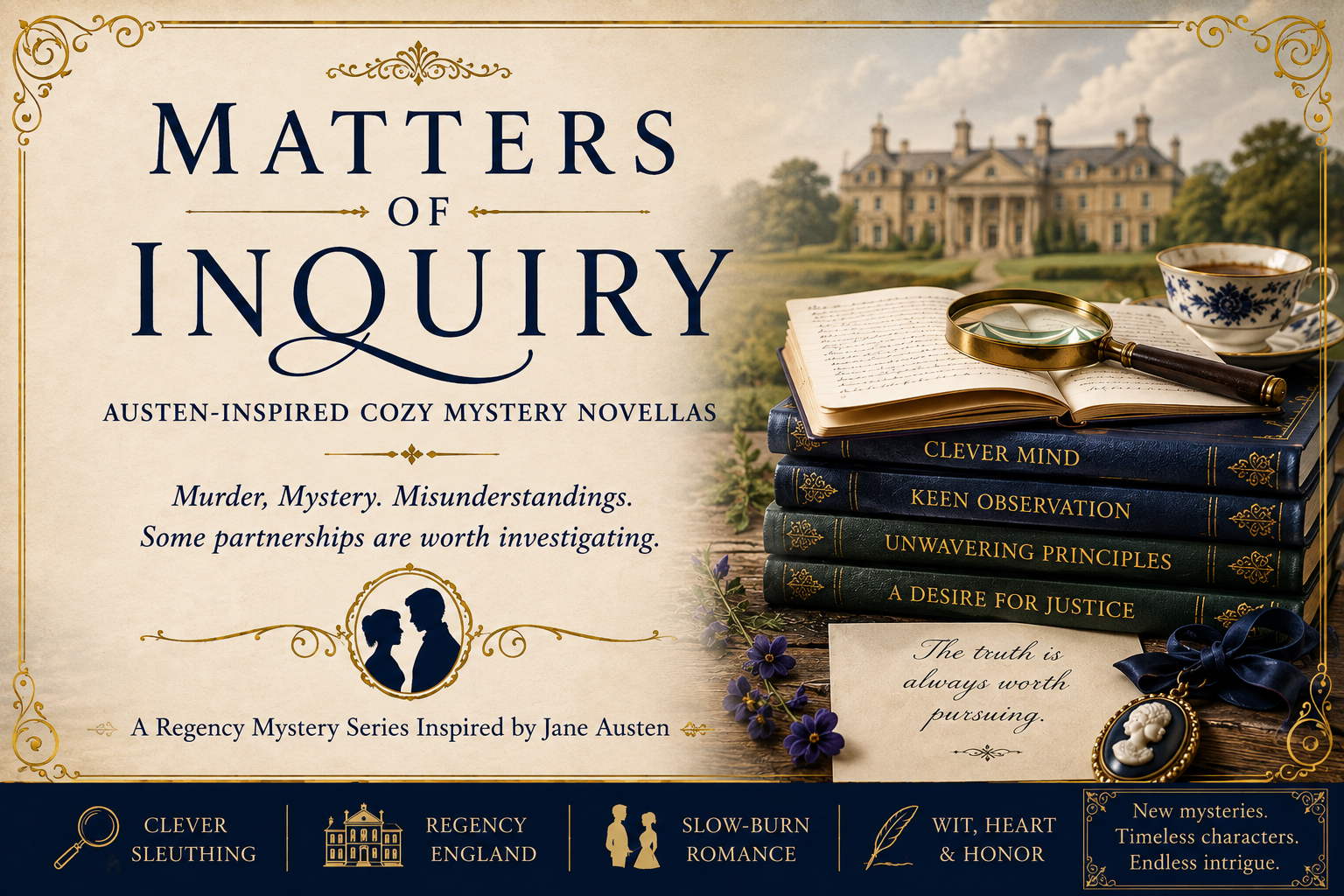
What if Miss Elizabeth Bennet had become one of Regency England’s most brilliant amateur investigators?
The morning after refusing Fitzwilliam Darcy’s proposal, Elizabeth Bennet stumbles upon a body hidden within the grounds of Rosings Park.
What begins as a single investigation soon becomes the first of many.
Armed with a sharp eye for detail, an unwavering determination to uncover the truth, and an instinct for seeing what others overlook, Elizabeth finds herself solving crimes the authorities dismiss, exposing secrets the fashionable world would rather leave buried, and discovering that justice often requires more than rank or reputation.
As each mystery draws Elizabeth and Mr. Darcy into a reluctant partnership, old prejudices give way to mutual respect, quiet admiration, and a romance that unfolds one investigation at a time.
Matters of Inquiry is a Regency cozy mystery series where every case uncovers more than a murderer.
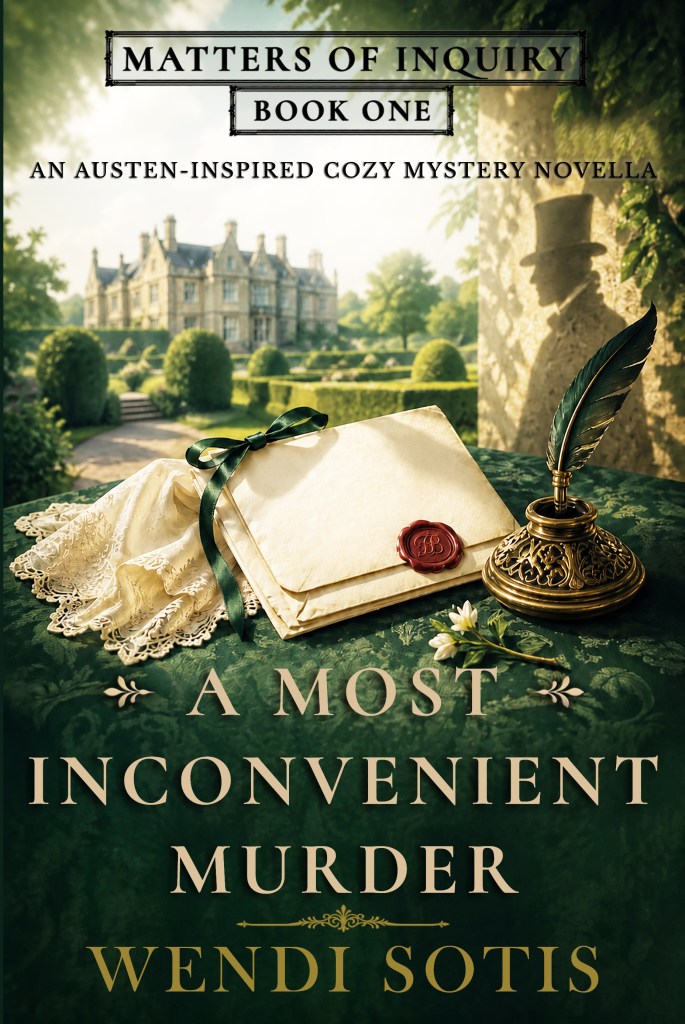
A MOST INCONVENIENT MURDER – BOOK ONE
After refusing to become his partner in life, she never imagined becoming his partner in the pursuit of justice.
Miss Elizabeth Bennet expected the morning after rejecting Fitzwilliam Darcy’s proposal to be awkward.
She did not expect to discover a dead woman hidden inside Lady Catherine de Bourgh’s hedge maze.
Lady Catherine wants the matter settled quietly. Since the victim appears to have died without violence, the coroner is willing, but Elizabeth refuses to believe the contrived cause of death.
Armed with little more than keen observation, relentless curiosity, and a determination to see justice done, Elizabeth begins asking questions others would rather avoid. Why was the victim carrying an expensive fragment of blue stationery? Why was evidence altered before the authorities arrived? And who benefits from declaring the death an unfortunate accident?
Hesitantly aided by Mr. Darcy, Elizabeth follows a trail of hidden motives, carefully guarded reputations, and long-buried secrets that reach beyond the walls of Rosings Park.
The more they uncover, the more Elizabeth realizes the greatest danger may not be the murderer at all… but how easily the truth can disappear when society decides it is inconvenient.
A Most Inconvenient Murder is the first book in the Matters of Inquiry series, a cozy Austen-inspired Regency mystery.
*** SAMPLE ***
A MOST INCONVENIENT MURDER
~ ~ ~ copyright 2026 ~ ~ ~
MATTERS OF INQUIRY – BOOK ONE
An Austen-Inspired Cozy Mystery Novella
by Wendi Sotis
Chapter 1
Although the morning had begun badly, Miss Elizabeth Bennet was quite certain it could not possibly grow worse.
She had not slept, although she thought she had achieved a faithful performance of slumber when the maid came in to stoke the fire, remaining motionless beneath the counterpane, eyes closed, hands folded beneath her cheek.
Contrary to how she might have appeared, even in the dawn’s light, the agitation of her mind was still painfully great. In truth, her mind had been ablaze with reviewing the events of the previous evening, for she could not avoid the real cause of her headache lingering into the morning.
It had been many hours since she had decided that not even Mr. Fitzwilliam Darcy deserved the force with which she had refused his proposal. “From the first moment of my acquaintance with you, your manners impressed me with the fullest belief of your arrogance, your conceit, and your selfish disdain of the feelings of others, laying the groundwork of disapprobation on which succeeding events have built an immoveable dislike. I had not known you a month before I realized that you were the last man in the world whom I could ever be prevailed upon to marry.”
“You have said quite enough, madam,” he replied to stop her from saying more, she guessed.
The recollection of his expression in that moment had not faded with the dawn. If anything, the remembrance had achieved a more perfect clarity with each of a hundred reanimations behind her closed lids: a peculiar mixture of outrage and disbelief. Beneath that was a vulnerability so raw that she felt it in her own heart every time she thought of it.
After taking a moment or two to collect himself, he had said, “I perfectly comprehend your feelings and have now only to be ashamed of what my own have been. Forgive me for having taken up so much of your time. Accept my best wishes for your health and happiness.”
That she should receive an offer of marriage from Mr. Fitzwilliam Darcy was astounding.
That he should have been in love with her for so many months? So much in love as to wish to marry her despite all the objections he had cataloged the previous evening?
Her astonishment increased with every review of it. It was almost incredible.
She had to admit it was gratifying to have unconsciously inspired so strong an affection.
But his abominable pride, and his shameless admission of what he had done with respect to separating Jane from Mr. Bingley could not be forgiven. In addition, the unfeeling manner in which he had mentioned Mr. Wickham, who had been treated with a cruelty that Mr. Darcy had not even attempted to deny.
These considerations soon overcame the pity that the deliberation of his attachment continually excited in her breast throughout the night.
While she wished her words could be unsaid, or at least softened, there was nothing she could do to make it so.
Sitting up, Elizabeth decided she needed to stop tormenting herself over it. She had always found motion a tonic for such maladies as this, so accordingly, she resolved to take advantage of the early spring sunlight.
Lacing her boots, she tied her bonnet and furrowed her brow in defiance of the headache. Slipping through the side door of the parsonage, she escaped before Charlotte could notice.
The grounds at Hunsford Cottage were humble in acreage but complicated in structure as a result of Lady Catherine’s improvements. From what Elizabeth understood, what had begun with the ambitious reshaping of a single garden walk had been refined into a network of formal beds with Charlotte’s encouragement of her husband spending a good deal of his free time out of doors instead of underfoot.
Elizabeth was, of course, expected to keep to the most visible promenades, but she was used to long rambles and had long ago discovered the less-frequented routes through Rosings Park.
Her boots crunched on the half-frozen moss as she inhaled the scent of peat and the damp of last night’s fog bank deeply. Her favorite of these walks was the so-called “observation path,” a term she had invented for Charlotte’s amusement, which wound behind a screen of boxwood and permitted an excellent view of Rosings Park’s grounds.
This morning, however, the memory of the proposal haunted the place, since Mr. Darcy had often found her there during her stay at the parsonage. In hindsight, she understood what she had missed during those encounters, though at the time she thought it was just bad luck.
Today? While she must assume the feelings that led him to find her in the park were now resolved, to be safe, Elizabeth chose the overgrown footpath behind the south garden, which was so little used that she had heard from the groundskeeper that it sometimes vanished entirely in the late-summer undergrowth.
She left the parsonage behind; dense tangles of hawthorn soon eclipsed its modest brick face. The air was cold, and the sky above the hedgerows hinted at bright sunshine to come.
Elizabeth allowed herself to believe she had at last escaped both her own thoughts and the residual embarrassment of having refused the offer of one of England’s most eligible men.
The pulse in her brow slowed. The quiet was so complete that she could hear her own breath. Further away, she detected the faint, intermittent clatter of sparrows pecking in the thicket.
At the end of the walk, a sloping field of grass gave way to reeds.
A footfall behind her alerted her that she was not alone. It was not the weightless patter of a servant, nor the brisk tread of Charlotte, but something heavier, more deliberate.
Her heart seized, for she knew before she turned that it would be Mr. Darcy. The knowledge struck her with a sharper headache.
He was standing on the path, not twenty paces distant, hat in hand, his hair less orderly than he usually allowed. His coat was dark with the faint shimmer of wool, still damp from the morning’s dew.
He looked neither hopeful nor contrite, simply present, as if the universe had ordained that wherever she went, he must materialize.
The force with which he occupied the path made it impossible to believe he had found her by accident.
They stood for a moment in complete silence. Then he bowed deeply, the way men did in salons but rarely in fields. He straightened with visible effort.
“Miss Elizabeth,” he said, his voice low. “I beg your pardon for intruding. May I entreat a word with you?”
Whilst in the privacy of her room, she had prepared several replies for when she next saw him, ranging from the withering to the icy, but at this exact moment, none presented itself. Instead, she inclined her head with a composure she did not feel.
Mr. Darcy advanced with so much caution that she barely heard his step upon the gravel. A slight motion at the corner of his mouth might have passed for the shadow of a smile had it not borne so near a resemblance to pain.
“I have written what I could not say yesterday. If you would—” Here his voice caught infinitesimally. “Please permit me to place this in your keeping. I ask that you do me the honor of reading it.”
He held out a letter, folded and sealed in the correct manner. The paper was uncommonly thick, and the seal unfamiliar. It was a dark impression, not the Darcy arms from his signet ring she had seen him press into letters to his sister at Netherfield Park, but something less ornate. The envelope shook very slightly in his hand.
Elizabeth took the letter. For one instant, their fingers brushed, and she felt a chill pass quickly up her arm, so sharp it might have registered as pain. Yet, she did not drop the letter.
She nodded her pledge to read it.
Mr. Darcy stepped back. “Thank you,” he whispered, and bowed again, less deeply.
She expected him to retreat at once, but instead he remained.
Being in the habit of observing others, it struck her that if she had been watching any other couple in the lane, she would have thought he was unwilling to deprive himself of these last moments in her presence.
His gaze was unblinking. She could not tell if he was angry, wounded, or simply taking a mental inventory of her for future reference.
Her breath caught as she thought, Is it possible he does not despise me?
No, that impression had to be wrong. After the horrid way she had refused him, it could not be true.
“Good day, Miss Elizabeth,” he said, and this time, his words carried the full weight of farewell. He put his hat on, turned away, and walked up the path. He did not look back.
Elizabeth’s breath caught. Watching him until he vanished beyond the bend, she turned away, tucking the letter deep into an inner pocket, where its rectangular solidity pressed cool against her ribs.
For a few minutes she wandered about, unable to decide whether she wished to read the letter immediately, or to hurl it into the nearest fire and pretend she had never seen it. But she had promised. And ultimately, curiosity won out. The possibility of a private justification—or, more thrillingly, an apology—proved irresistible. But it could not be read in the open, where anyone passing might recognize the handwriting and bear witness. At the parsonage, the possibility of Charlotte entering her room unannounced was not merely theoretical. It would be much better to find a location out of doors that offered a bit of privacy.
She turned back toward the gardens, considering her options.
The solution appeared with the suddenness of a lightning flash: Lady Catherine’s hedge maze.
Elizabeth had discovered its existence only by accident, on a day when she was attempting to find paths where Mr. Darcy might not find her.
The maze was composed of tightly clipped yew, and at its center stood an abandoned marble fountain and a single wooden bench. As far as she could tell, no one ever went there except the gardener, who continued to trim the hedges even though his mistress was displeased with the labyrinth’s design.
It was, in short, the perfect place to read a letter that should never have existed.
Elizabeth quickened her step, her headache abating in proportion to her growing anticipation. The maze was at the far end of the grounds.
Stepping into the labyrinth, she was instantly enveloped in a stillness unlike any other on the property. The yews were so dense they absorbed most of the wind; the only sound was the uneven crunch of gravel beneath her feet.
Since the path to the center was already known to her, she arrived at the fountain quickly, heart pounding in her chest as if she had committed some great crime. The fountain itself was grotesque—two cherubs struggling with an urn that had, over the years, sprouted a tuft of lichen from its spout. The basin was empty of water; the surface speckled with last autumn’s leaves.
Elizabeth placed a handkerchief on the bench and seated herself before extracting the letter from her coat. The paper was smooth beneath her fingers—high quality. The blue tint on the pages led her to assume it was specially made.
The seal broke with a satisfying snap, and she unfolded it. Two whole sheets were covered on both sides, written in a precise hand, utterly unlike the impetuous manner in which he had spoken the evening before.
He must have been awake all night, as she had been, though it looked as though his night had been spent more productively than hers.
She read the first side of a page. It was about Jane and Mr. Bingley, the page ending with, “The serenity of your sister’s countenance and air was such as might have given the most acute observer a conviction that, however amiable her temper, her heart was not likely to be easily touched.”
Elizabeth blinked several times, as if doing so would erase the words from the page.
What would he have thought if her sister had shown her real feelings for Mr. Bingley, for all to see? Would he not have criticized her for being too forward?
Anger was too mild a word for what she felt at this moment.
She made a few exclamations, then read it again, more slowly this time. By the time she finished her second pass, her hands trembled; whether from cold or emotion she could not say. As she finally turned the page over, she decided to pace a bit to warm herself and expel a portion of her exasperation before continuing.
Rising from the bench, she headed left around the fountain. The moss under her shoes was slick, prompting her to grab hold of the cold marble with one hand.
While steadying herself, she noticed what she had not seen upon entering: on the far side of the basin was something barely visible above the lip. The form was swathed in a shade of rose in style just now, quite inconsistent with the green and gray of the surrounding area. For a split second, her mind supplied an explanation: perhaps it was a lady’s scarf or glove, carelessly placed on the fountain’s edge and forgotten.
However, it looked wrong.
Elizabeth moved further around the fountain, letter still in hand. As she approached, the shape resolved itself with devastating clarity.
It was a woman, seated—or rather, folded—against the curved wall of the fountain, her dress splayed about her as if she had sunk from exhaustion. One arm hung at an unnatural angle. Her rose-colored bonnet was askew; the ribbons half-unwound and trailing down to the dead leaves around her. Her brown hair lay across her cheek in a way that was not at all intentional. The skin was very flushed, almost matching the color of her hat.
Elizabeth’s first, wild thought was that the woman had fainted, perhaps overcome by a headache similar to the one that had afflicted her.
But even as the thought formed, it dissolved. The position was unnatural. The stillness was too perfect, too total.
It was the posture of death.
Her letter fluttered from her fingers.
She reached the woman in two quick steps and crouched, ignoring the dampness that chilled her knees.
A splash of color on the woman’s chin caught Elizabeth’s attention, but she was distracted by her lips being a peculiar cherry-red. Eyes wide, the woman looked upward; her expression spoke of glimpsing something astonishing in her final moments.
Elizabeth’s heart hammered in her ears. She reached for the woman’s hand, intending… what? She did not know; to rouse her, perhaps? Offer comfort?
Confirm a conclusion of which she was already certain?
The hand was cold and stiff; the gloved fingers closed in a desperate clutch around an object Elizabeth could not at first identify. It was thin and irregular, mayhap a scrap of paper.
Elizabeth forced herself to look closer. The object was a torn piece of stationery, its edges jagged. There was ink on it, but the death-grip of the hand obscured the words. Elizabeth could make out only the end: “…ackstone.”
The name sent a shock through her. She had heard it only recently. Not only had Miss Anne de Bourgh mentioned it when she and Charlotte had gone to Rosings for tea, but Charlotte had also mentioned that the woman had come to see her only yesterday.
Miss Diane Blackstone was the companion to a lady at the nearby estate of Willow Grange.
Mrs. Blackstone ought not to be inside the hedge maze at Rosings Park at all, let alone should she have died there.
Elizabeth staggered back, bile rising in her throat.
The horror was not in the death itself; she had seen death before and had never flinched. The horror was in the absurdity of Elizabeth’s own experience… as if fate had decided that one improbable event in the last day was not sufficient, and had provided a second, ghastlier incident, only to eclipse the first.
She heard herself make a wailing sound, high and sharp. It echoed in the yew walls. For a moment, she feared it might carry all the way to Rosings or Hunsford Cottage, summoning Mr. Collins and Lady Catherine and the whole weight of the social order to descend upon her at the very moment she least wished to be observed.
The sound faded. The maze was as silent as ever.
As she stood there, a stiff breeze blew through the branches of the yews. Papers fluttered around Mrs. Blackstone, the vision spurring Elizabeth to remember Mr. Darcy’s letter.
Bending, she collected the pages. Something about them seemed wrong somehow, difficult to fold, but she knew she could not allow anyone else to find these pages.
Folding the papers into her inner pocket, Elizabeth leaned forward once more and closed Mrs. Blackstone’s eyes.
Knees shaking, she perched on the bench, stared at the fountain, which from this vantage point blocked the sight of Mrs. Blackstone… hoping to find the will to move again.
Regaining a bit of rationality, she stood, retrieved her kerchief, wiped the damp from her skirts, and started out of the maze.
Elizabeth had been quite certain the morning could grow no worse. She had never been more mistaken.
Instead, it had become the day that changed everything.
******** ******** ********
To read more, get it on Amazon.com.
Available on Kindle Unlimited!

